The Builder's Playbook · 06 of 6
Build a Business, Not Just a Product
Achieve profitability, build a moat, and design the business—and life—you actually want.
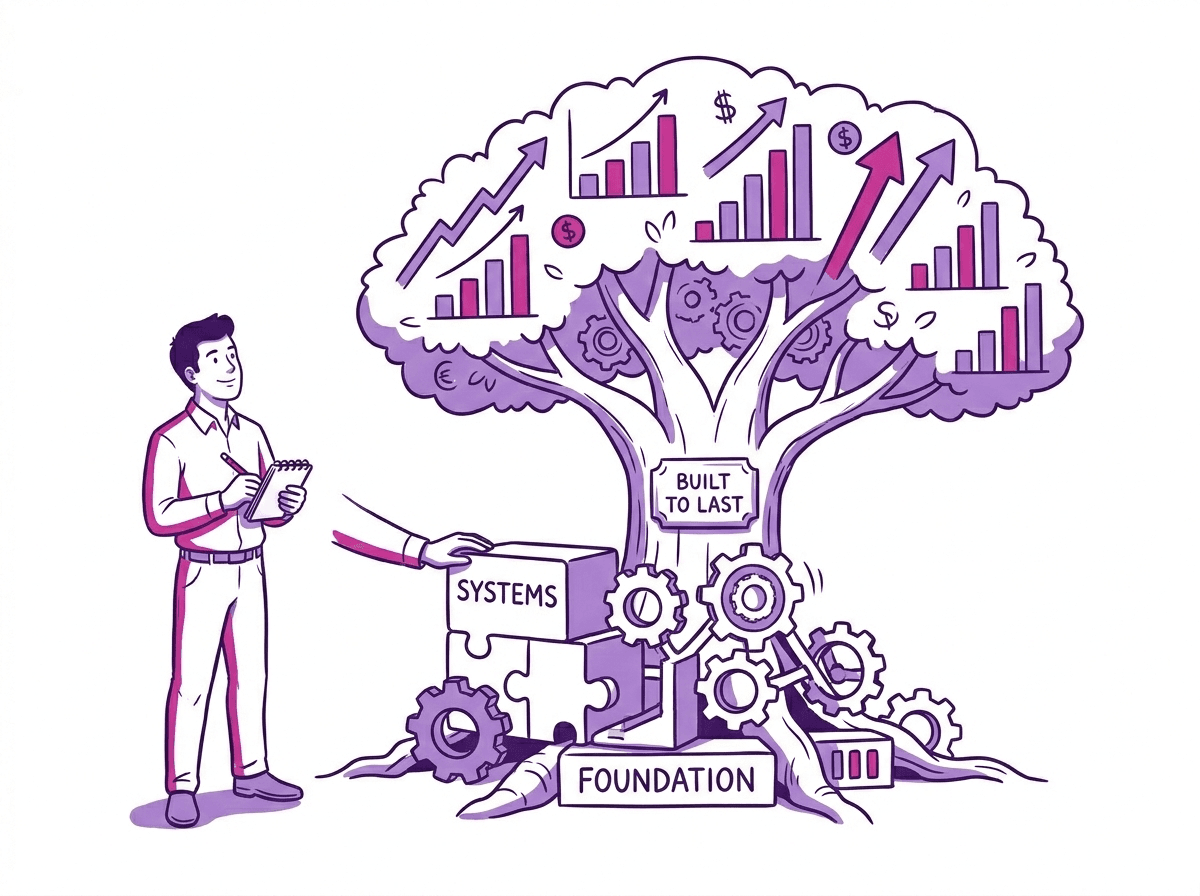
SUSTAIN
Build a Business, Not Just a Product
SaaS Capital, 2025 — of bootstrapped SaaS companies are breakeven or profitable, compared to just 46% of VC-backed
You’re past $10K MRR. The business works. Revenue grew. Customers arrived. The product improved. You proved that your idea has legs.
But somewhere between your 100th and 1,000th customer, a different question starts nagging: is this what I actually want? Not whether the business can succeed—you’ve proven that. Whether the life this business creates is the life you want to live.
This isn’t a luxury question. It’s the most strategic question you can ask. Because a founder who’s building toward someone else’s definition of success will eventually burn out, make bad decisions, or sell too early. This playbook is about building with intention—profitability, moats, lifestyle design, and choosing your endgame from a position of strength.
Everything you need to validate your idea in 30 days.
What kind of business do you actually want? Lifestyle vs. venture-scale. The three currencies: money, time, freedom.
Unit economics for real. The SaaS metrics that matter. Cutting costs that don't drive growth.
Brand, community, data, network effects. Building moats as a solopreneur. Community as the ultimate moat.
Designing your week. Maker vs. manager time. Mental health and isolation. When to take a break.
The 3-year vision exercise. Product roadmap. Platform risk. Building predictable income.
Keep and run it. Hire a CEO. Sell the business. How to decide what game you're actually playing.
Complete sustainability framework covering the sustainability mindset, profitability metrics, moat building, founder operating system, long-term strategy, and endgame options.
Pre-built workspace with Sustainability Score assessment, unit economics calculator, moat audit template, weekly operating system planner, 3-year vision exercise, and endgame decision framework.
Eight diagnostic questions to evaluate your business across profitability, moat strength, channel diversification, work-life balance, and long-term vision. Know exactly where you stand.
Weekly schedule templates for maker vs. manager time, decision fatigue reduction frameworks, and the energy audit to design your week for sustainability, not burnout.
Track LTV, CAC, gross margin, and the metrics that actually matter for long-term sustainability. Includes pricing audit framework and expansion revenue triggers.
Keep and run it, hire a CEO, or sell the business. A structured decision framework to evaluate your options from a position of strength, not desperation.
A pre-built Notion workspace with frameworks, trackers, and action items from every chapter — ready to use immediately.
Jason Fried and David Heinemeier Hansson built Basecamp in 2004. Twenty years later, the company generates reportedly ~$280M in revenue with just 71 employees. They’ve turned down 100+ VC offers, run a 4-day summer workweek, and wrote REWORK.
~$280M in revenue, 71 employees, zero outside investors. The gold standard of intentional business building.
You don’t need to grow forever. You need to build something worth keeping. Basecamp’s product suite generates revenue far exceeding what most VC-backed startups achieve—without sacrificing the founders’ quality of life.
Ben Chestnut and Dan Kurzius bootstrapped Mailchimp for 20 years. In 2021, Intuit acquired them for $12 billion—the largest bootstrapped exit in history. At the time, Mailchimp had ~$800M in annual revenue and over 13 million customers.
$12 billion acquisition after 20 years of bootstrapped growth. The largest bootstrapped exit in history.
The founders who hold out the longest often get the best outcomes. Mailchimp’s moat was 20 years of brand recognition and customer trust. No amount of VC funding could have replicated that.
John O’Nolan raised $300K through a Kickstarter campaign in 2013 and built Ghost into a $10M+ ARR publishing platform with 20,000+ paying customers. The key decision: Ghost is structured as a non-profit foundation with a legal constitution that prevents acquisition.
$10M+ ARR publishing platform that can never be bought. Sustainability built into the legal structure.
If your goal is to build something that outlasts you, build the permanence into the legal structure. Ghost will serve its community regardless of what happens to any individual.
The business works — but is it the business you want? Master unit economics, build defensible moats (brand, community,...
Annual members get all playbooks included in their plan.
Learn more30-day money-back guarantee. No questions asked.
Not every resource is for everyone. Here's a quick way to know if this playbook aligns with where you are right now.
Get more playbooks together and save. Each bundle includes instant access to every playbook listed.
For founders in the idea and early-build stage
Save $50
For founders who have launched and are pushing for scale
Save $50
This playbook is included
All 6 playbooks + combined Notion workspace
Save $127
This playbook is included
